Sound library managers for Unity compared
Soundly, Sononym, Eagle and Asset Inventory compared for game sound libraries: search, similar sounds, playback, editing, Asset Store packages, Unity imports and price.
A game’s sound library usually comes from three places: audio packs bought on the Asset Store, bundles and pro libraries downloaded as WAV folders, and your own recordings. Which manager fits depends mostly on that mix, and on where the sounds have to end up: in a DAW, in middleware such as Wwise or FMOD, or directly in Unity.
The four contenders
Soundly
Soundly, from Soundly AS in Oslo, is built for sound designers in post-production and games. It indexes local, external and network folders where they are and adds a cloud library: Pro includes about 250,000 sounds, unlimited local files and 10 GB of cloud storage for US$14.99 a month billed yearly or US$19.99 billed monthly, before VAT. The free plan has every feature, more than 3,000 free sounds and room for 10,000 local files. Search covers keywords with a thesaurus, UCS categories, a natural-language search that analyzes local files on your machine, Find Similar for sounds that sound alike, and speech transcription. Playback shows waveform and spectrogram, with region selection, pitch, markers and export with handles. Integrations reach Pro Tools, Logic, Reaper and other DAWs, Wwise, FMOD Studio and Unreal Engine 5.4 to 5.6. It runs on Windows and macOS, with an experimental Linux beta. We found no Unity integration and no support for archives or Unity packages.
Sononym
Sononym, from Sononym UG in Berlin, is a sample browser that listens to your files. It analyzes folders in place, sorts sounds into categories with machine learning, detects loops and one-shots, and filters by length, loudness, brightness and pitch. Its similarity search lets you weight spectrum, timbre, pitch and amplitude, and can start from a library file, an outside file, a selected region or a live recording, all offline. Dragging a selection out exports only that part. A license is a one-time €89 or US$99 for Windows, macOS and Linux, with a 30-day trial. There is no cloud library, no team feature and no game engine integration, and it reads audio files only.
Eagle
Eagle is a general asset library for designers that many game developers also use for sounds. It shows waveform thumbnails, plays a file while you hover over it, changes playback speed and filters by detected BPM. It costs US$34.95 once for two devices on Windows and macOS. It copies every imported file into its own library, recommends fewer than 250,000 items per library and cannot open archives or Unity packages. The Eagle comparison covers it in detail.
Asset Inventory
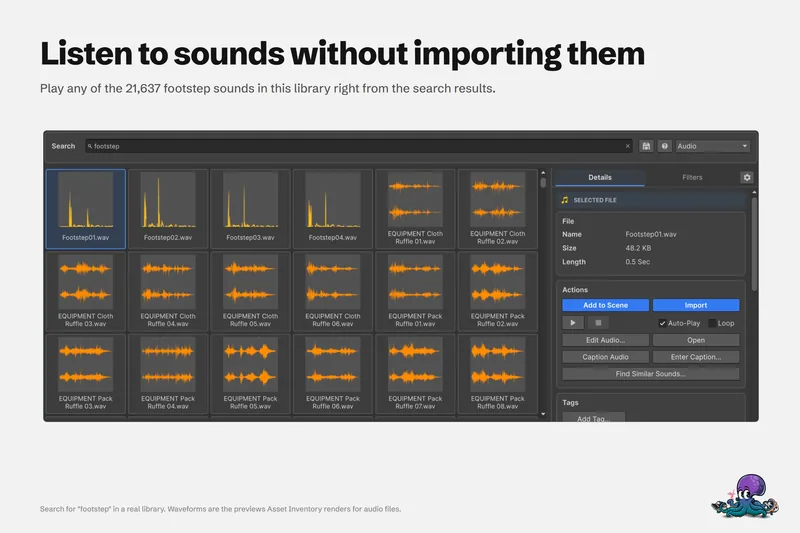
Asset Inventory is a Unity Editor extension that indexes everything you own, sounds included. It reads every audio file inside your Asset Store purchases, custom packages, ZIP, RAR and 7z archives and folders, without extracting them first. You search by name, folder and length, play and scrub sounds in the results, trim them with Edit Audio… and import only the file you picked, or drag it straight into the Scene. Optional AI writes descriptions and tags for what each sound contains, and Find Similar Sounds compares how clips sound with an embedding model running on your own computer. Free online catalogs add Openverse and Wikimedia Commons sounds to the same results. In Unity projects that use FMOD for Unity with Unity’s own audio switched off, it plays, scrubs and analyzes sounds through FMOD instead. It is a one-time Asset Store purchase per seat. The library behind our guides holds 906 hours of audio across 4,935 packages.
Feature comparison
| Soundly | Sononym | Eagle | Asset Inventory | |
|---|---|---|---|---|
| Built for | Sound designers, post-production, games | Music producers and sample collectors | Designers; any file type | Unity developers, inside the Editor |
| Library model | Indexes folders in place, plus cloud | Indexes folders in place | Copies files into its library | Indexes packages, archives and folders in place |
| Asset Store packages | No | No | No | Every sound inside indexed |
| ZIP, RAR, 7z archives | No | No | Third-party plugin | Contents indexed |
| Included sounds | 3,000+ free, about 250,000 with Pro | None | None | Free Openverse and Wikimedia Commons catalogs |
| Similar sounds | Find Similar | Weighted similarity search, offline | No | Find Similar Sounds, local model |
| Search by meaning | Natural-language search | Machine-learning categories | Text only | Optional AI descriptions and tags |
| Filters beyond text | UCS categories | Length, loudness, brightness, pitch | BPM range | Length, with sort by length |
| Editing | Pitch, speed, reverse, normalize, export with handles | Drag out a selection | Third-party plugin | Trim and remove silence before import |
| Into the game | Drag and drop; Wwise, FMOD, Unreal | Drag and drop | Drag the library copy | Import or drag into Project, Hierarchy or Scene |
| Teams | Shared network databases, cloud, admin panel | No | Library on a NAS | Shared database or MySQL/MariaDB |
| Platforms | Windows, macOS, Linux beta | Windows, macOS, Linux | Windows, macOS | Unity Editor on Windows and macOS |
| Price | Free plan; Pro US$14.99 a month yearly | €89 or US$99 one-time | US$34.95 one-time | One-time Asset Store purchase per seat |
Which one fits your library
- Most of your sounds came from the Asset Store. Asset Inventory is the only manager here that can search them at all without importing every package first, and it puts the sound you pick into your project.
- You work with pro WAV libraries in a DAW, Wwise or FMOD. Soundly is the strongest dedicated tool, and its cloud library is a real bonus. Asset Inventory can index the same folders for the Unity side, and if your Unity project uses FMOD for Unity, it keeps auditioning working inside the Editor by playing sounds through FMOD.
- You produce music from sample packs. Sononym’s categories, filters and offline similarity search are made for that, for a one-time price.
- You want sounds, images and references in one app. Eagle works for loose files, as long as the extra disk space for its copies and its item limit are acceptable.
Narrower tools fill other niches: BaseHead for post-production, with a free edition and one-time licenses from US$149; Resonic, a fast Windows player that is free for personal use, with a paid Pro version; AudioCortex, the macOS successor to AudioFinder; and ADSR Sample Manager for music producers.
Using them together
Soundly, Sononym and Asset Inventory all index folders where they are, so they can share one sound library on disk. Keep auditioning, editing and middleware work in Soundly or Sononym, and add the same folders to Asset Inventory as Additional Folders. Asset Inventory then searches them together with the audio inside your Asset Store packages, and the sound you pick ends up in Unity without a detour.
Read on: searching a Unity sound library with Asset Inventory, AI search with local captions, or Asset Inventory vs Eagle.
Frequently asked questions
What is the best sound effects library manager for Unity?
It depends on where your sounds come from. For sounds bought on the Asset Store, Asset Inventory is the only manager here that searches inside .unitypackage files and imports straight into Unity. For pro WAV libraries used with DAWs, Wwise or FMOD, Soundly is the strongest dedicated tool, and Sononym suits musicians who want offline similarity search.
Does Soundly work with Unity?
Soundly integrates with DAWs, Wwise, FMOD Studio and Unreal Engine, and you can drag sounds into any app. We found no Unity integration and no support for .unitypackage files or archives.
Which sound managers find similar sounds?
Soundly's Find Similar, Sononym's weighted similarity search and Asset Inventory's Find Similar Sounds all compare how clips actually sound. Sononym and Asset Inventory run it entirely on your own computer.
Can I use Asset Inventory together with Soundly or Sononym?
Yes. Soundly, Sononym and Asset Inventory all index folders where they are, so Asset Inventory can add the same WAV folders as Additional Folders next to your Asset Store packages without copying anything.
Find any Unity asset you own. Import only what you need.
Keep reading
 Use case
Search your whole Unity sound effects library without importing
Package names say little about the sounds inside. Search every audio file you own by name and length, listen in the results, trim before import, and let a local model caption, tag and match sounds.ComparisonAsset Inventory vs Eagle for game assets and sound libraries
Eagle organizes images, video, fonts, sounds and references beautifully. Unity packages are opaque to it, and every import is a copy. Where each tool fits for art and sound libraries, and how game teams use both.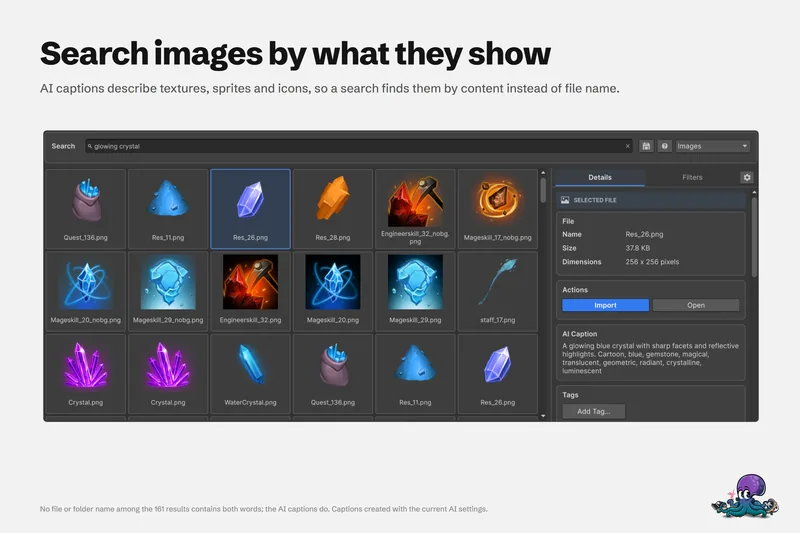 Use case