Pixel pitch for game developers
Pixel pitch explained for game developers: emitters per meter, cabinet math, why viewing distance rules disagree, and how big one LED appears on screen in Unity.
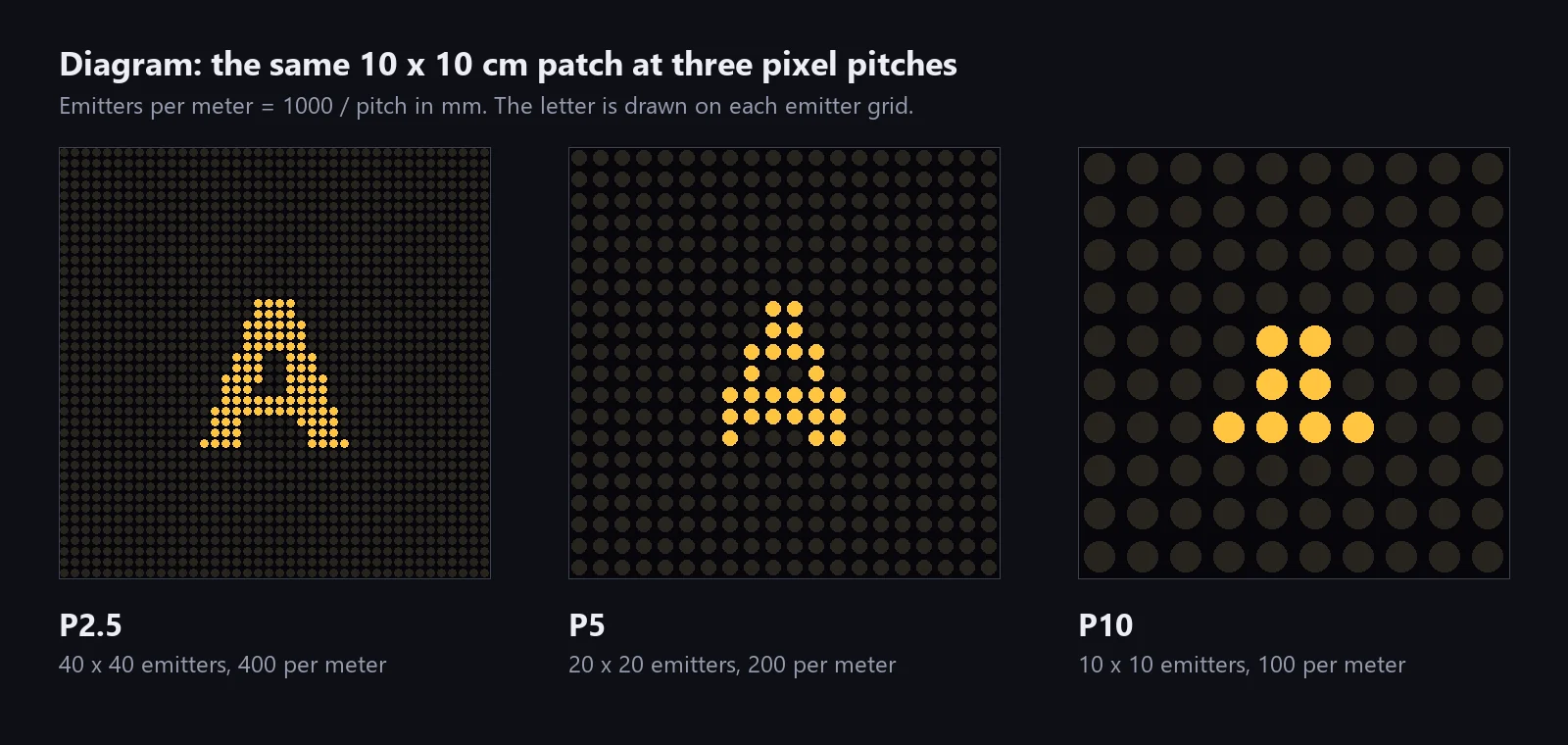
LED walls are specified in P-numbers: P2.5, P3.9, P10. Game engines think in pixels and units. Pixel pitch is the bridge between the two, and once you can convert it in both directions, sizing a believable board for a game camera stops being guesswork.
What pixel pitch means
Pixel pitch is the distance from the center of one LED pixel to the center of the next, in millimeters. Christie and Planar both define it this way. A P3.9 wall has 3.9 mm between pixel centers, a P10 board 10 mm. A smaller number means a denser grid and more detail up close, and in the real world a higher price, because more LEDs fill the same area.
LED Studio calls each light point an emitter, because it simulates the visible light source rather than an image pixel, and every board stores its pitch in millimeters.
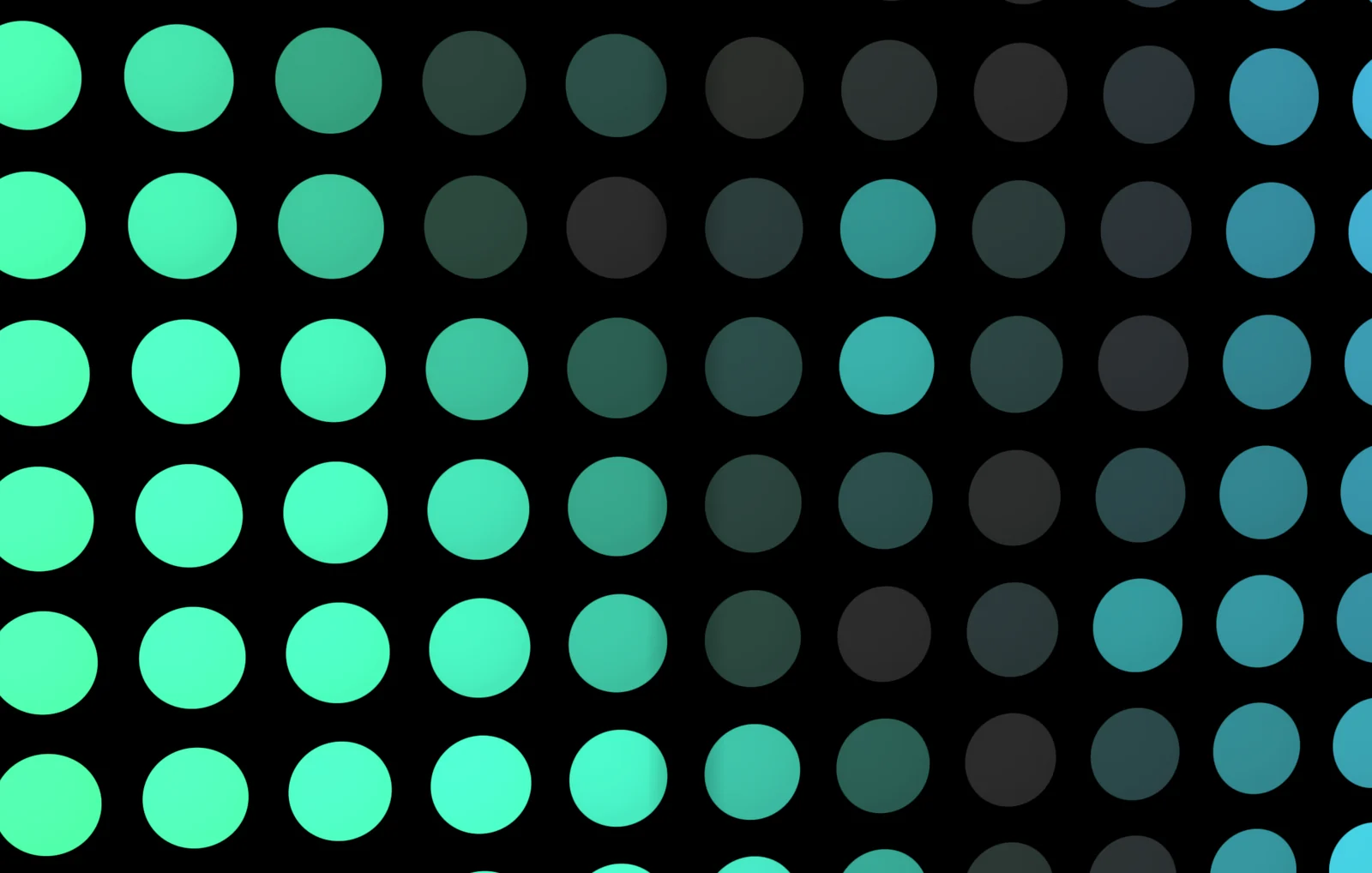 Round emitters in a regular grid: the pitch is the distance from one dot’s center to the next, measured across the black gap.
Emitters per meter and cabinet math
Everything follows from one formula: emitters per meter = 1000 / pitch in millimeters.
| Pitch | Emitters per meter | Emitters per square meter |
|---|---|---|
| P2.5 | 400 | 160,000 |
| P3.9 | about 256 | about 65,700 |
| P5 | 200 | 40,000 |
| P6 | about 167 | about 27,800 |
| P10 | 100 | 10,000 |
| P16 | 62.5 | about 3,900 |
| P20 | 50 | 2,500 |
Real walls are built from cabinets, and cabinets from modules. A 500 x 500 mm cabinet at P3.9 holds 500 / 3.9 ≈ 128 emitters per side, so about 128 x 128 = 16,384 emitters (128 x 3.9 mm = 499.2 mm). Eight of those across and four high make a 4 x 2 m wall of about 1024 x 512 emitters. LG’s GPPA perimeter board shows the same arithmetic in a real datasheet: its P10 version combines modules of 40 x 30 pixels on 400 x 300 mm, four by three per cabinet, into 160 x 90 pixels on a 1,600 x 900 mm screen.
Typical pitches and where they go
The LED Studio manual groups pitches by feel:
| Pitch | Typical feel | Good use |
|---|---|---|
| P2.5 / P3.9 | Fine detail, readable closer to camera | Stage backdrops, trade show walls, hero screens |
| P5 / P6 | Balanced detail and visible LED character | Scoreboards, venue screens, medium-distance signage |
| P10 / P16 / P20 | Chunky, obvious diode pattern | Large outdoor boards, stylized retro displays, distant ribbons |
Manufacturer pages line up with it. Daktronics offers 3.9, 5.9, 10 and 15 mm for its indoor ribbon boards, LG’s GPPA perimeter series comes in 6.25 and 10 mm, and Christie lists 0.9 to 2.5 mm among common values for LED video walls.
Viewing distance: the rules of thumb disagree
Vendors translate pitch into viewing distance, but not the same way:
- Christie suggests about one meter of minimum viewing distance per millimeter of pitch.
- Planar describes three methods: a 10x rule (pitch times 10 gives feet), the visual acuity distance at which a viewer with 20/20 vision stops seeing individual pixels (pitch times 3,438 gives millimeters), and an average comfortable viewing distance, which its table puts at half the acuity distance.
| Pitch | Christie | Planar 10x rule | Planar comfortable | Planar visual acuity |
|---|---|---|---|---|
| P2.5 | 2.5 m | 25 ft (7.6 m) | 4.30 m | 8.60 m |
| P10 | 10 m | 100 ft (30.5 m) | 17.19 m | 34.38 m |
For the same P10 board the answers range from 10 m to more than 34 m. Planar adds that none of these methods is definitive and that comfort is ultimately up to the owner of the screen. For a game, the numbers only tell you where a real spectator stops seeing dots. Your camera decides what the player sees.
From pitch to pixels on screen
What matters in a game is how many screen pixels one emitter covers:
pixels per emitter = (pitch / distance) x screen height / (2 x tan(vertical FOV / 2))
With a 60-degree vertical field of view at 1080p, an object one meter tall seen from one meter away spans about 935 pixels. In millimeters and meters that gives a handy shortcut: pixels per emitter ≈ 0.935 x pitch in mm / distance in m.
| Board | 1 m away | 3 m away | 10 m away | 30 m away |
|---|---|---|---|---|
| P3.9 | 3.6 px | 1.2 px | 0.36 px | 0.12 px |
| P10 | 9.4 px | 3.1 px | 0.94 px | 0.31 px |
| P20 | 18.7 px | 6.2 px | 1.9 px | 0.62 px |
Double the numbers at 2160p, and scale them up for narrower lenses. Two thresholds explain most of what you see:
- A round dot with a dark gap needs several pixels before it reads as a dot. Smaller than that, the grid beats against the pixel grid, the effect described in Moire on LED screens in Unity.
- Below one pixel per emitter, individual emitters cannot be drawn at all. A correct renderer shows their average color, and the board reads as a continuous image, just like a real wall seen from beyond its viewing distance.
The table also explains a habit of game art. At typical game camera distances, real pitches fall below a pixel, so stylized boards often use a far coarser pitch than real hardware to keep the LED look.
Choose the lowest resolution that sells the board
LED Studio’s performance guidance puts it in one line: choose the lowest logical resolution that still sells the display at the target camera distance. A board composes its content at its emitter resolution, so a perimeter board seen from the stands does not need the emitter count of a P3.9 hero wall.
Two strategies work:
- Physically correct. Use the real pitch and size, for example to preview an installation. Distant boards then read as smooth images, which is what a spectator would see. The LED wall previsualization use case covers that workflow.
- Stylized. Pick a coarser pitch so emitters land at a few pixels or more at your usual camera distance. The Arena Showcase scene that ships with LED Studio 1.7.0 works this way: its ribbon panels use 128 x 20 emitters at about 40.6 mm pitch, its hero wall 512 x 192 emitters at 28 mm.
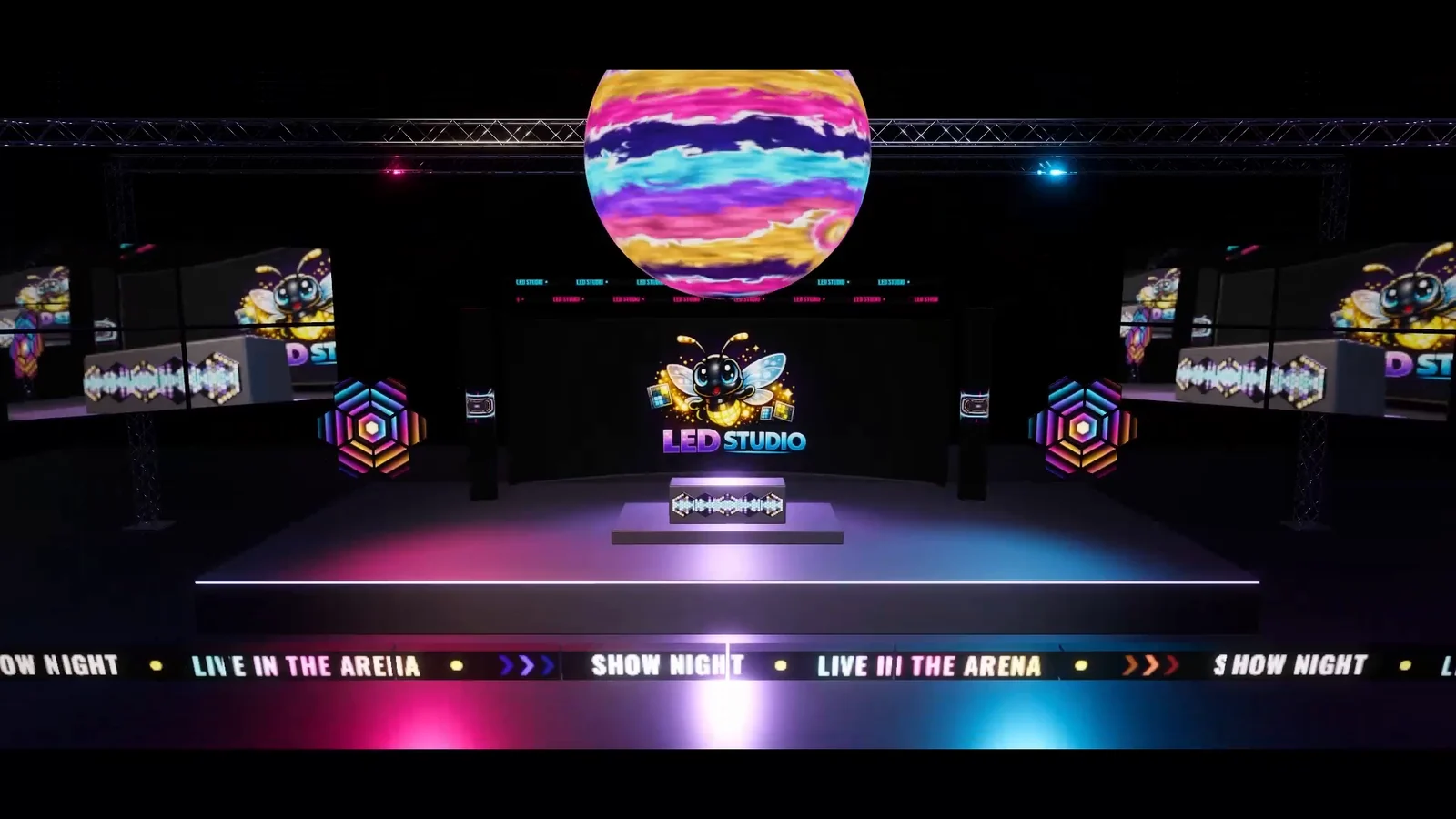 A wide shot of the arena film: the spherical display above the stage, the center screen with the LED Studio logo, hexagon panel clusters, side screens and a front ribbon reading SHOW NIGHT and LIVE IN THE ARENA.
How LED Studio turns pitch into size
A board’s physical size is its emitter count times its pitch. A 192 x 108 board at P3.9 is about 0.75 x 0.42 m; the same grid at P10 is 1.92 x 1.08 m, a different physical object with the same content resolution. The LedPitchPreset struct offers P2.5, P3.9, P5, P6, P10, P16 and P20 and accepts any millimeter value. Auto Size From Pitch keeps the transform scale matched to the logical resolution and pitch, and PhysicalSizeMeters reports the result. Choose cabinet columns and rows that divide evenly into the emitter count, such as 128 x 128 emitters per cabinet at P3.9.
To go the other way, from a surface size to an emitter count, convert the pitch into emitters per meter. A sketch, assuming board references a LedBoardController:
// Fill a 6 x 1 m surface at P10: 100 emitters per meter gives 600 x 100 emitters.board.SetPitch(LedPitchPreset.P10);board.SetEmitterCountForSize(new Vector2(6f, 1f), 1000f / LedPitchPreset.P10.PitchMM);board.SetAutoSizeFromPitch(true);Debug.Log(board.PhysicalSizeMeters); // (6.00, 1.00)Pitch also feeds the rendering. LED Studio’s close-up and far blending follow emitter screen size, so a board with a real pitch shows diode detail and blends into a smooth image at the distances its size implies.
Frequently asked questions
What does P3.9 mean on an LED wall?
It is the pixel pitch: 3.9 mm from the center of one LED pixel to the center of the next. That is about 256 emitters per meter, so a 500 x 500 mm cabinet holds about 128 x 128 emitters.
How far away should you view a P10 LED screen?
It depends on whose rule you follow. Christie suggests about one meter of minimum viewing distance per millimeter of pitch, roughly 10 m, while Planar lists 17.19 m as the comfortable distance and 34.38 m as the visual acuity distance for 10 mm.
How many screen pixels does one LED cover in a game?
Divide the pitch by the camera distance and multiply by the screen height divided by twice the tangent of half the vertical field of view. At 1080p and a 60-degree vertical field of view, a P10 emitter seen from 10 m covers about 0.94 pixels.
Does LED Studio calculate board size from pitch?
Yes. Physical size is emitter count times pitch, so 192 x 108 emitters at P10 make a 1.92 x 1.08 m board. Auto Size From Pitch keeps the transform scale matched, and SetEmitterCountForSize derives an emitter count from a surface size.
LED screens, walls and signs that look like real hardware.
Keep reading
 Use case
LED wall previsualization in Unity
Plan screens in physical units, judge them from real seat and camera positions, play the actual content, sequence a show on the Timeline and record a mockup video, with an honest list of what LED Studio does not do compared with show previz suites.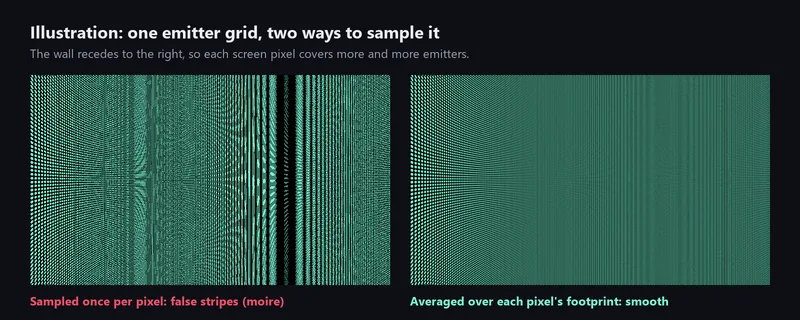 Article
Moire on LED screens in Unity, and how to fix it
Moire is aliasing between a screen's emitter grid and the camera's pixel grid. Why it grows with distance and motion, the usual shader and camera fixes, and how LED Studio blends emitters into a smooth image without changing brightness.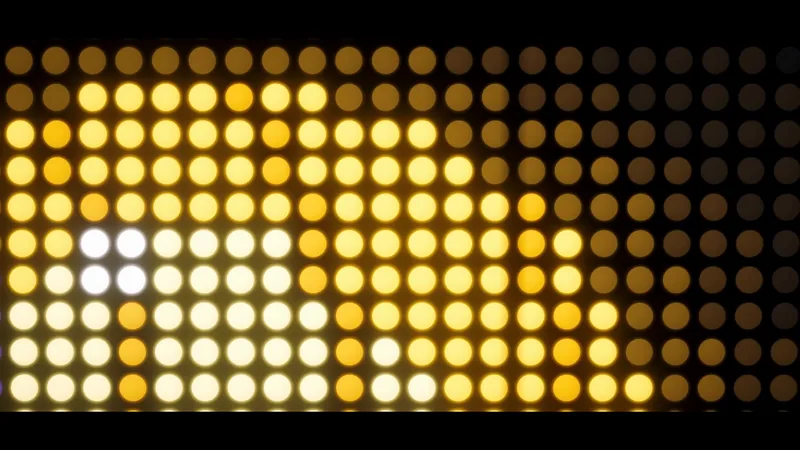 Use case