Random and name generator assets for Unity compared
Randomly, Random Generator 2.0, NameFactory and other Asset Store tools compared with Mock Magic for names, gameplay randomness, test records, series and streams.
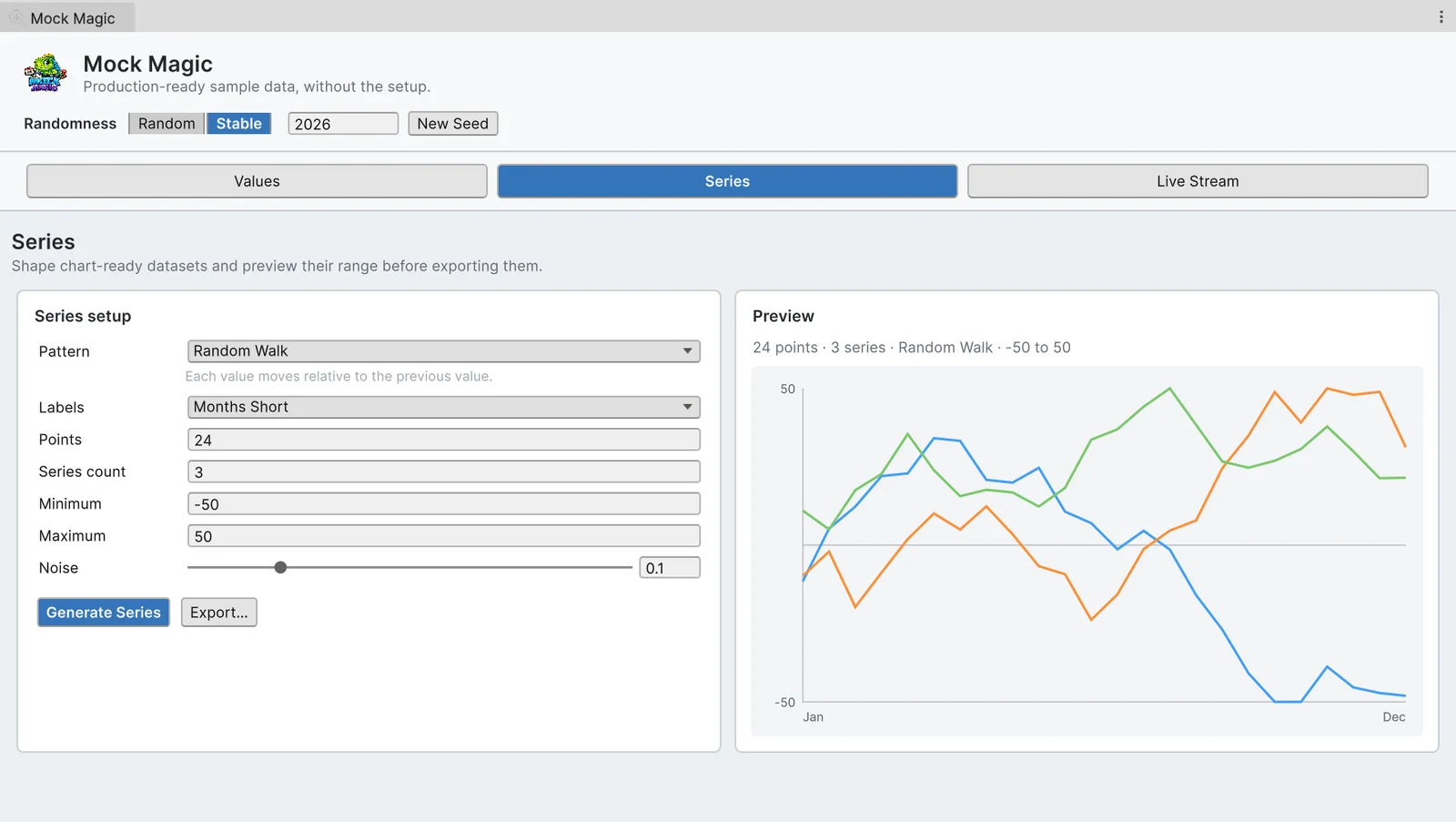
Search the Asset Store for “random” or “name generator” and you find two kinds of tools that look alike but do different jobs. Picking the wrong kind costs time in both directions.
Two different jobs
Gameplay randomness and in-game names. Loot rolls, procedural levels, spawn positions, NPC names and gamer tags are part of the game. Players see them, so names must fit the world and randomness must feel fair: weighted drop tables, distributions, noise, and often separate generators per system, so a change to the loot table does not shift the level layout.
Test and demo data. A leaderboard before the backend exists, a customer table, a chart before analytics, a dashboard before the devices are online. Players never see this data. It has to look plausible, fill every field, repeat exactly for tests and screenshots, and sometimes change over time like a live feed.
Most assets below are built for the first job. Mock Magic is built for the second.
The options
| Asset | Price | Focus | Latest version |
|---|---|---|---|
| Randomly | US$9.99 | Gameplay randomness: distributions, vectors, colors, enums, strings, passwords, lorem ipsum, names, noise, weighted lists, editor window | 1.0.4, October 2026 |
| Random Generator 2.0 | US$4.99 | 124 generators: fantasy races, places, 19 cultural name sets, sci-fi, gamer tags | 2.0, September 2026 |
| NameFactory | US$15 | Culture-aware names for 198 countries, person and family generation | 1.0.0, August 2026 |
| Character Name Generator | US$5 | 61,896 given names and 158,024 family names | 1.0.4, May 2025 |
| Name Card | US$5 | Random names | 2.0.1, November 2022 |
| Easy Name Generator | Free | Random names | 1.1, June 2020 |
| Name and Place Generator | Free | Real names from U.S. census data, and places | 1.02, October 2017 |
| Unified Random Framework | US$29.99 | General randomness framework | 2.1.1, September 2026 |
| True Random PRO | US$9 | Random numbers from atmospheric noise | 2024.1.1, March 2024 |
| Mock Magic | Free | Test and demo data: 57 value types, typed records, chart series, live streams, export | 1.5.0 |
Prices in US dollars and versions as listed on the Asset Store on the date above, except for Mock Magic, which shows the version this site describes. Prices shown in other regions differ.
Where the dedicated assets are stronger
- Names that fit a world. Fantasy races, sci-fi crews and gamer tags come from Random Generator 2.0. Mock Magic has no fantasy or sci-fi names at all.
- Names by culture. NameFactory covers 198 countries and generates people and families, and Character Name Generator ships tens of thousands of given and family names. Mock Magic’s built-in lists hold a few hundred first and last names from many regions, with no way to choose a culture.
- Gameplay math. Randomly bundles distributions, vectors, noise and weighted lists with an editor window. Mock Magic has weighted picks and a Gaussian helper but no coherent noise such as Perlin noise and no helpers for random directions or positions, and all of its generators share one seed, while gameplay systems usually want independent ones. Separate
System.RandomorUnity.Mathematics.Randominstances fill that gap for free, as the article on random seeds shows. - True randomness. True Random PRO provides numbers from atmospheric noise. That suits a draw nobody should be able to predict or reproduce, and it is the opposite of what a test needs.
Where Mock Magic fits
- Test records. 57 data types, from names and e-mail addresses to card numbers, ISBNs, user agents and reviews.
MockPersonkeeps name, e-mail address and username consistent, andMockOf<T>fills your own classes through explicit setters. - Chart series and live streams. The Series workspace has 15 patterns and 17 label presets, and the Live Stream workspace emits points on four rhythms in Edit Mode and Play Mode.
- Repeatable output. Stable mode in the Generator and
Mock.Seedin code repeat the same data for tests and screenshots. - Export. Values and series leave the Generator as Text, CSV, JSON or C# arrays.
- Price. Free with source code, and included with Chart Guru.
Combining them
Mock Magic templates accept custom tokens, so a name generator asset can supply the names while Mock Magic supplies the rest of the record. The call into the other asset depends on its API, so this sketch takes it as a delegate:
using System;using MockMagic;
public static class GuildRoster{    // nameSource wraps whatever call your name generator asset provides    public static string[] Create(Func<string> nameSource, int count)    {        Mock.RegisterToken("heroName", nameSource);        Mock.RegisterToken("level", () => Mock.Integer(1, 61).ToString());        Mock.RegisterToken("joined", () => Mock.Date(yearsBack: 3, yearsForward: 0));
        Mock.Seed(12); // repeats Mock Magic's values; seed the name asset as its docs describe        string[] rows = Mock.Parse("{{heroName}}, level {{level}}, joined {{joined}}", count);        Mock.ResetSeed(); // also frees UnityEngine.Random, which Mock.Seed seeds too        return rows;    }}
The reverse matters as well: Mock.Seed also seeds UnityEngine.Random until Mock.ResetSeed, so near gameplay code that relies on Unity’s generator, prefer MockOf<T>.UseSeed, which restores the previous state after its pass.
Sources
- The Asset Store pages linked in the table, for price, latest version and release date.
- Mock Magic’s key features and scripting API manual pages.
Which one to choose
- Players will read the names: Random Generator 2.0 for fantasy and sci-fi, NameFactory or Character Name Generator for real names by culture. The free name assets work for a prototype, but their last updates date from 2020 and 2017.
- Players will feel the randomness: Randomly or Unified Random Framework for a ready toolkit, or
System.RandomandUnity.Mathematics.Randomat no cost. True Random PRO only when unpredictability is the point. - The data fills screens, charts and tests: Mock Magic, free on the Unity Asset Store. The article on random strings, IDs and enums shows where its one-liners replace hand-written helpers.
- Both at once: register the name asset as a Mock Magic token and let each tool do its own job.
Frequently asked questions
Which Unity asset generates fantasy names?
Random Generator 2.0 (US$4.99) includes generators for fantasy races, places, sci-fi names and gamer tags. Mock Magic generates real-world names for test data, not fantasy names.
Can Mock Magic replace a gameplay random library?
For simple jobs. Mock.Pick, Mock.PickWeighted, Mock.Enum and MockRandom.Gaussian cover picks, weighted drops and bell-shaped values from one shared generator. There is no Perlin-style noise, no helper for random directions and no separate generator per system, which gameplay code often needs.
Is true randomness better for games?
Rarely. Tests, replays and bug reports need sequences you can repeat, which a seeded pseudo-random generator gives you. True random numbers, such as True Random PRO's atmospheric noise, suit draws that nobody should be able to predict or reproduce.
Can I use a name generator asset together with Mock Magic?
Yes. Register a Mock Magic token that calls the other asset's generator, then use it in templates next to Mock Magic's built-in tokens.
Realistic fake data for Unity, from one value to a live stream.
Keep reading
 Use case
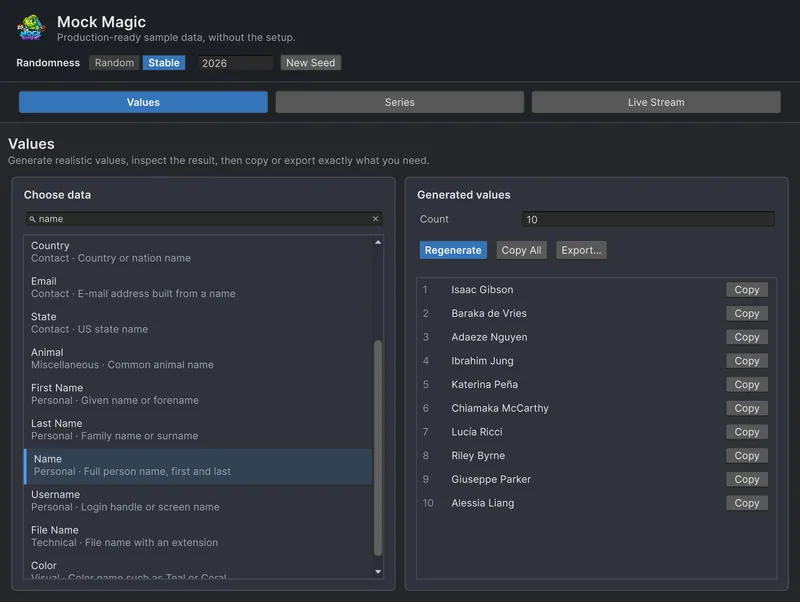
Generate names and text at runtime
What Mock Magic's name, username, e-mail, place, lorem ipsum, review and hacker phrase generators return, how large their pools are, and when a dedicated name generator is the better choice.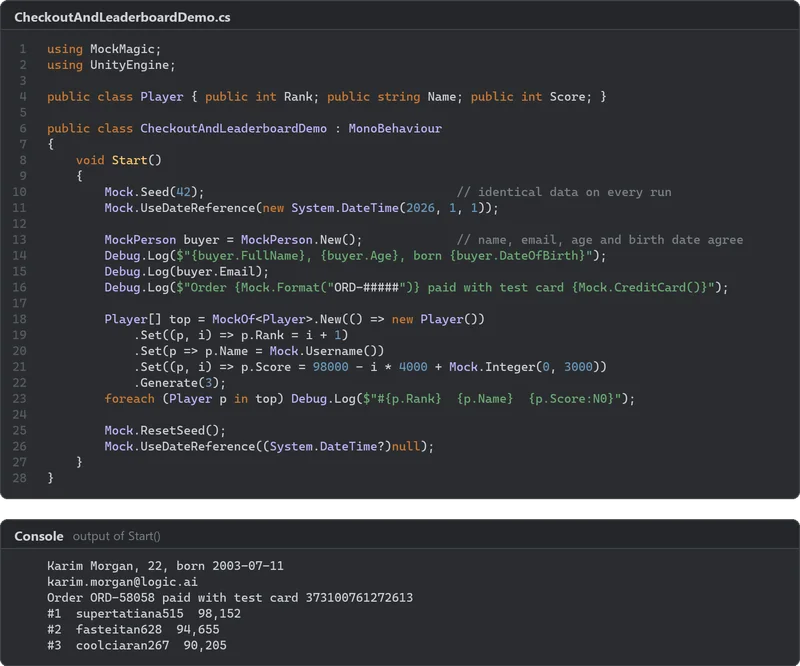 Use case
Mock leaderboards, chat logs and shop reviews
Fill leaderboards, chat panels, shop pages and social feeds with generated usernames, scores, messages, prices, ratings and reviews, including the ties, long names and empty states that break layouts.ArticleRandom strings, IDs, colors and enum values in Unity
Copy-paste C# for the small random values every Unity project needs: codes from a character set, GUIDs, unique counters, colors, enum values and weighted picks. Then the Mock Magic one-liners that do the same, seeded and ready for tests.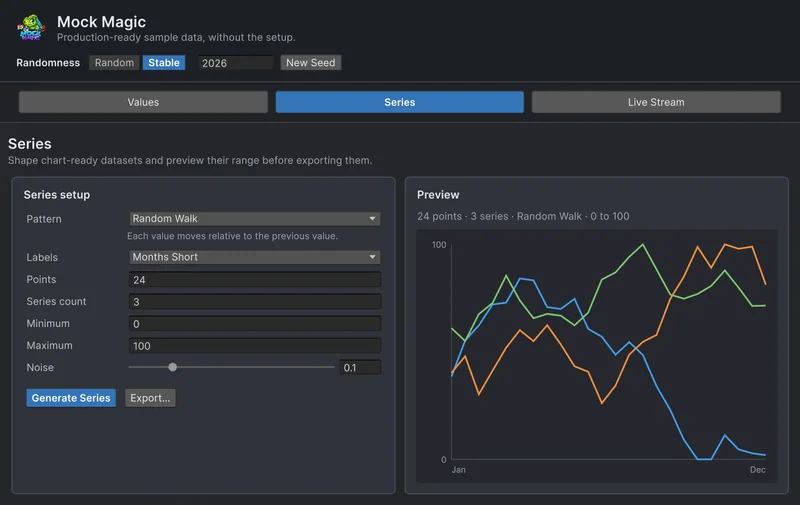 Comparison