Choose Output and Performance
Choose an output mode
- Combined Mesh: the simplest static and animated dimensional output.
- Chunked Combined Mesh: efficient updates when only part of changing text needs rebuilding.
- Per Letter GameObjects: independent objects for authored per-letter workflows.
- Hybrid: combined readability with selected independent behavior.
- LOD Group: automatic distance-based detail.
- Physical Letters: pooled letters with convex collision proxies for physics.
Start from a performance profile
Static Quality favors final detail. Realtime balances changing text and effects. Massive Text lowers cost for large populations. Interactive keeps one raycastable combined mesh with automatic distance quality. Physical prepares pooled independent letters. Adjust lower-level quality only after the closest profile has been measured in the real scene.
Mesh Detail Presets
Draft, Balanced, High, and Hero coordinate curve tolerance, bevel rings, cap and relief subdivisions, body steps, decoration detail, contour tubes, and depth-sweep sampling. Use Draft while shaping and arranging, Balanced for ordinary real-time content, High for close readable text, and Hero for final capture or unusually close presentation. Choose Custom only when the coordinated presets cannot express the measured requirement.
Mesh Detail answers how finely geometry is built. Performance Profile answers how that geometry is owned and updated. Keep those decisions independent: a Hero title can be static or frozen, while a dense interactive menu can use Balanced detail with the Interactive workload profile.
Changing text and runtime overrides
Appended and changed text can reuse existing chunks and unchanged detailed letters. Runtime overrides can change visibility, depth, tint, material, and quality without rewriting the authored style. For repeated temporary labels, use TextStudioEmitter with a complete 3D host so the normal Text Studio lifecycle, profiles, aggregation, stacking, follow behavior, and Unity-backed pooling remain shared with flat text. Prewarm the characters and emitter hosts that must appear without a first-use build; the reusable geometry workspace starts smaller and grows only when detailed lettering requires more capacity.
Dense combined 3D text now responds more quickly when several effects update most of a detailed mesh. Three-dimensional effects and shared animation channels restore automatically across repeated Fast Enter Play Mode sessions, while player-build validation checks the bundled materials, Material Sets, shaders, and default font data.
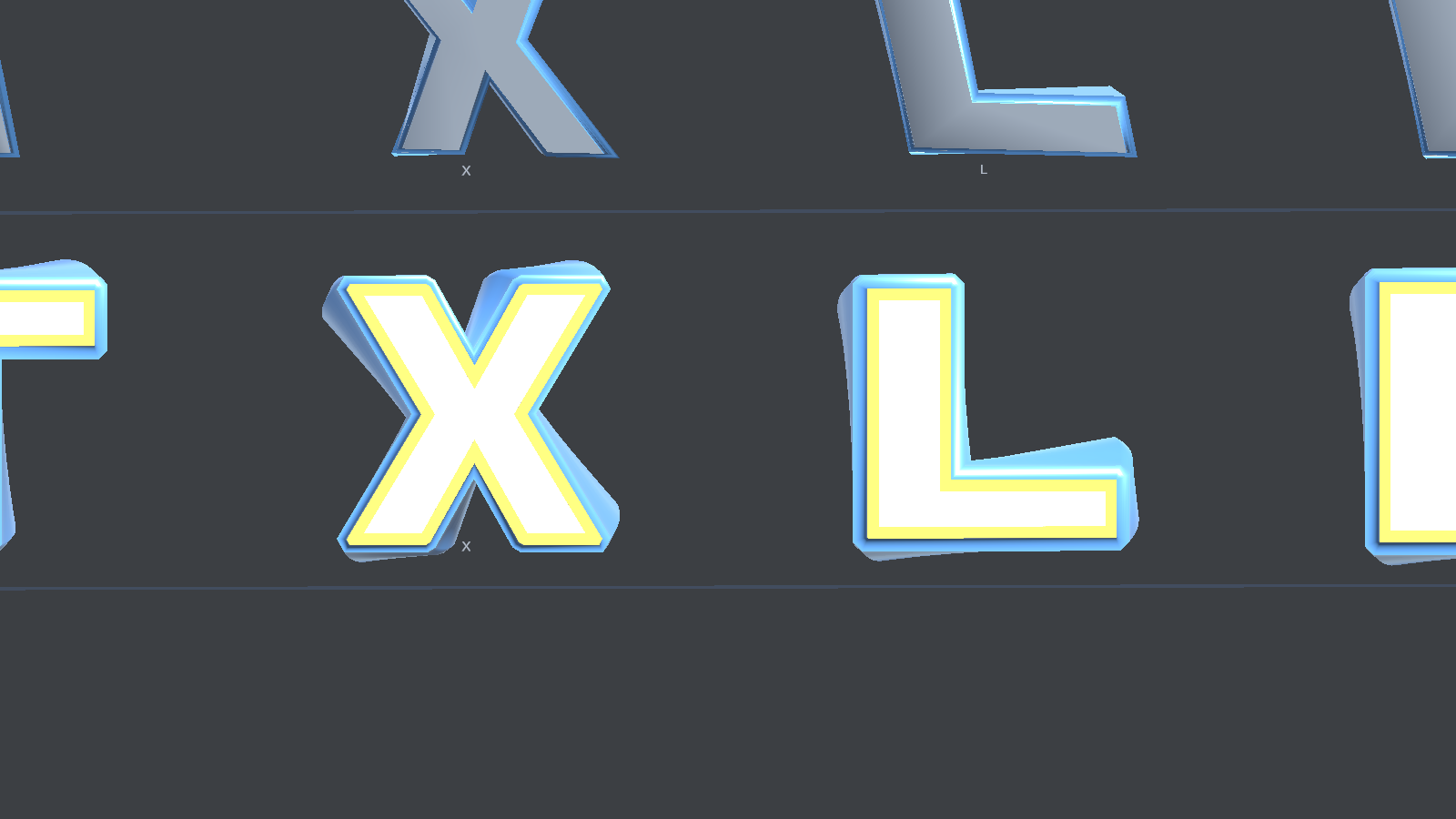
Combined output remains readable under a large changing-text workload.
Freeze a finished title
Strict Freeze captures the exact visible frame as persistent static geometry. Choose Freeze Current Appearance under Geometry Actions after setting the desired preview progress. The current glyphs, colors, transparency, placement, deformation, materials, LOD membership, and mesh colliders remain, while Text Studio generation, animation, tags, events, sockets, Scramble progression, and runtime text changes stop.
Use Unfreeze to restore live editing. The generated snapshot is removed after the last frozen copy is restored. Freeze works on one selected scene object or prefab instance, not a Prefab Mode asset. Physical letters keep their captured poses and colliders, but rigidbody simulation stops.
Choose output by workload
Combined Mesh is the simplest static and fully compatible output. Chunked Combined Mesh limits replacement work when changing text preserves parts of the previous output. Per Letter GameObjects provide independent objects. Hybrid combines retained output with selected independent behavior. LOD Group produces distance-based detail. Physical Letters adds pooled rigidbody-ready objects.
- Static title or sign: Combined Mesh or Strict Freeze.
- Frequently changing short label: Realtime profile with Chunked Combined Mesh.
- Large passage or many glyphs: Massive Text with measured chunk size and automatic LOD.
- Raycastable sign or control: Interactive profile and one root collider where possible.
- True collisions or falling letters: Physical profile and Physical Letters.
Performance profiles
Static Quality favors final detail. Realtime balances changing text and effects. Massive Text lowers cost for large populations. Interactive keeps one raycastable combined mesh with automatic distance quality. Physical configures independent letter behavior. Profiles never replace authored layers or materials. Apply the closest workload first, then tune measured bottlenecks.
Quality, LOD, and topology effects
Curve Tolerance controls outline sampling. Smooth Angle controls normal continuity. Automatic LOD chooses detail bands. Parallel Vertex Threshold decides when the automatic animation backend can profitably use parallel work. Topology Effect Refresh Rate and Quantization Steps bound Contour Bloom and Bevel Pulse.
Runtime Statistics
Use glyph, entry, vertex, triangle, mesh, renderer, and material counts to understand output size. Use topology and visual update times to distinguish rebuild work from warmed animation. Use cache hits, misses, replacements, and evictions to understand reuse. Use output-object and collider counts to detect hierarchy growth. Use geometry validation only when diagnosing integrity.
Prewarming and bounded caches
PrewarmGlyphs synchronously warms at most 256 unique Unicode scalars per call without replacing the visible mesh. Use loading screens or pool warm-up, not a frame with strict responsiveness. Build Preparation is the durable solution for Prepared only players; PrewarmGlyphs is a runtime readiness tool, not a substitute for build coverage.
Reusable Geometry stores raw topology. Placement, surface mapping, materials, supported deformation, and runtime visual channels are applied afterward, so compatible objects can share the expensive base without sharing presentation. Mutable custom paths without durable identity, grouped Word or Line or Whole Text contours, pre-geometry modules, and topology-changing post-geometry modules can prevent reuse or Prepared only compatibility.
The shared geometry cache is bounded by entry count and 64 MiB of estimated mesh payload. Local outline and codepoint caches are also bounded. Frequent eviction usually means too many simultaneous fonts, quality levels, path identities, styles, or topology variants. Reduce unnecessary variability before retaining more data.
Schedule versus rebuild
RebuildGeometry requests topology immediately through the normal hub refresh. ScheduleGeometryBuild coalesces repeated requests into one later component update and can be canceled before dispatch. Scheduling is deferred main-thread work, not background mesh generation. Do not call either method every frame.
Strict Freeze
Freeze Current Appearance captures the exact visible frame as persistent static geometry. The snapshot retains current glyphs, colors, transparency, placement, deformation, materials, LOD membership, and mesh colliders. Text Studio generation, animation, tags, events, sockets, Scramble progression, and runtime text changes stop.
Unfreeze restores live editing and removes generated snapshot data after its last frozen owner is restored. Freeze is an editor transaction for a selected scene object or prefab instance, not a runtime API for Prefab Mode assets. Treat frozen output as ordinary static meshes in player code.